Block Party
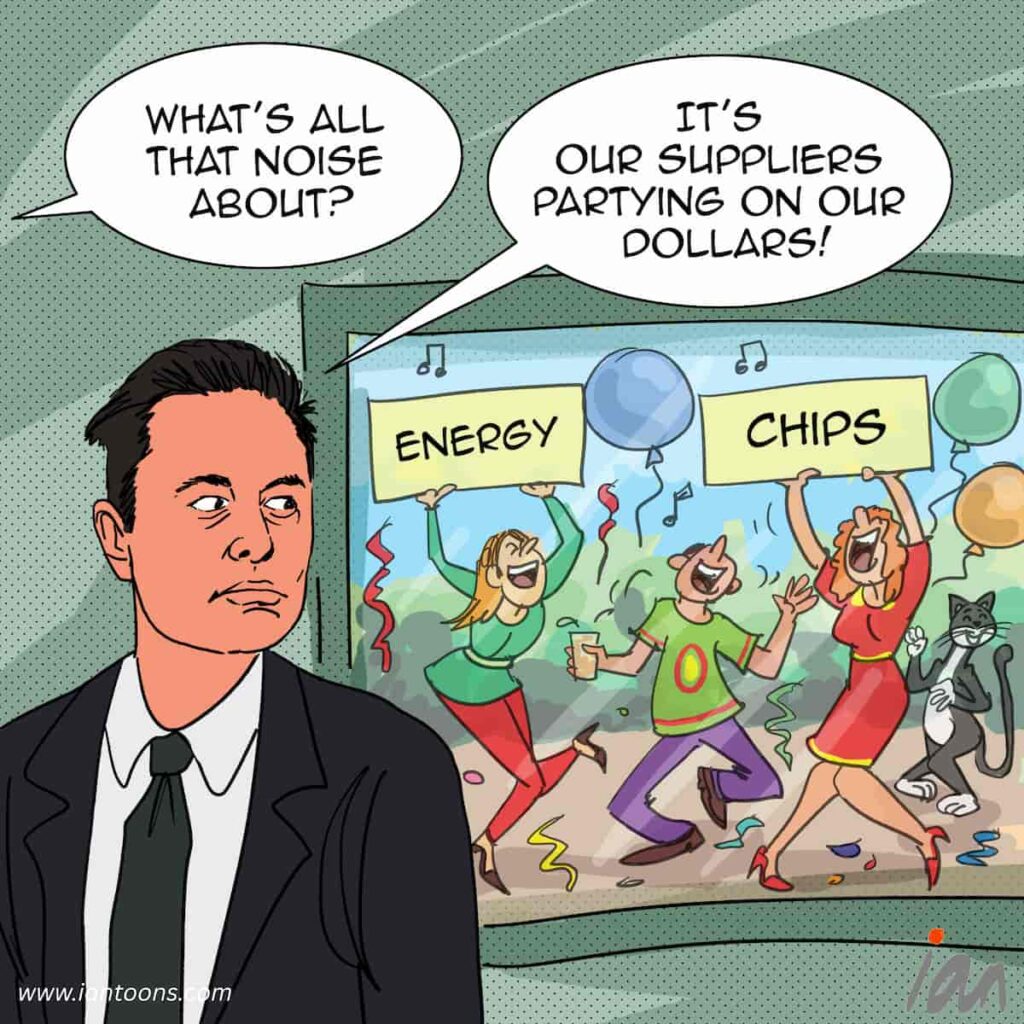
Block Party – A cartoon that illustrates that if there is an AI bubble forming, it is forming at the edges of the market.
In last week’s tech earnings, Alphabet, Amazon and Microsoft continued to report strong growth and expanding margins, supported by sustained demand for cloud and AI services. Their investment programmes, now exceeding $600 BN annually, are largely funded from operating cash flow, not debt. Previous industry bubbles were driven by excess leverage, for example during the telecom investment bubble of 1998–2002, when over $500 BN was deployed into global telecom infrastructure. So if there is a bubble it’s not happening at the core of the market, therefore we must look elsewhere for potential signals.
Private markets are the first place this is starting to show up. Global venture funding reached roughly $330 BN in the first quarter of 2026 (!), with a disproportionate share flowing into a small group of firms such as OpenAI, Anthropic and xAI. Multi-billion-dollar rounds have become routine, often implying dominant outcomes in a market that has not yet stabilised. Signs of a bubble are showing up among suppliers, particularly in energy and data-centre infrastructure. Companies like VSAT Data have seen massive valuation increases, driven as much by supply bottlenecks as by demand. Meanwhile, retail investors are increasingly seeking indirect exposure to private AI companies through structured vehicles (e.g. Destiny Tech100), a familiar late-cycle pattern.
Maybe this points to a different way bubbles form than what we’ve seen more recently. When capital is abundant and balance sheets are strong, excess doesn’t start with debt, it starts with overcommitting to a narrative before the economics are proven.
14
–
1
Sources:
Gil Press (Feb 27, 2026) -The State Of The $1.7 Trillion AI Bubble: The End Of Thinking – Forbes
Jason Snyder (Nov 17, 2026) – The AI Bubble That Isn’t There – Forbes
Sasha Rogelberg (March 29, 2026) – One AI bubble has already burst. The next one—a ‘rare’ kind—is still growing, economist warns – Fortune