Collective Action
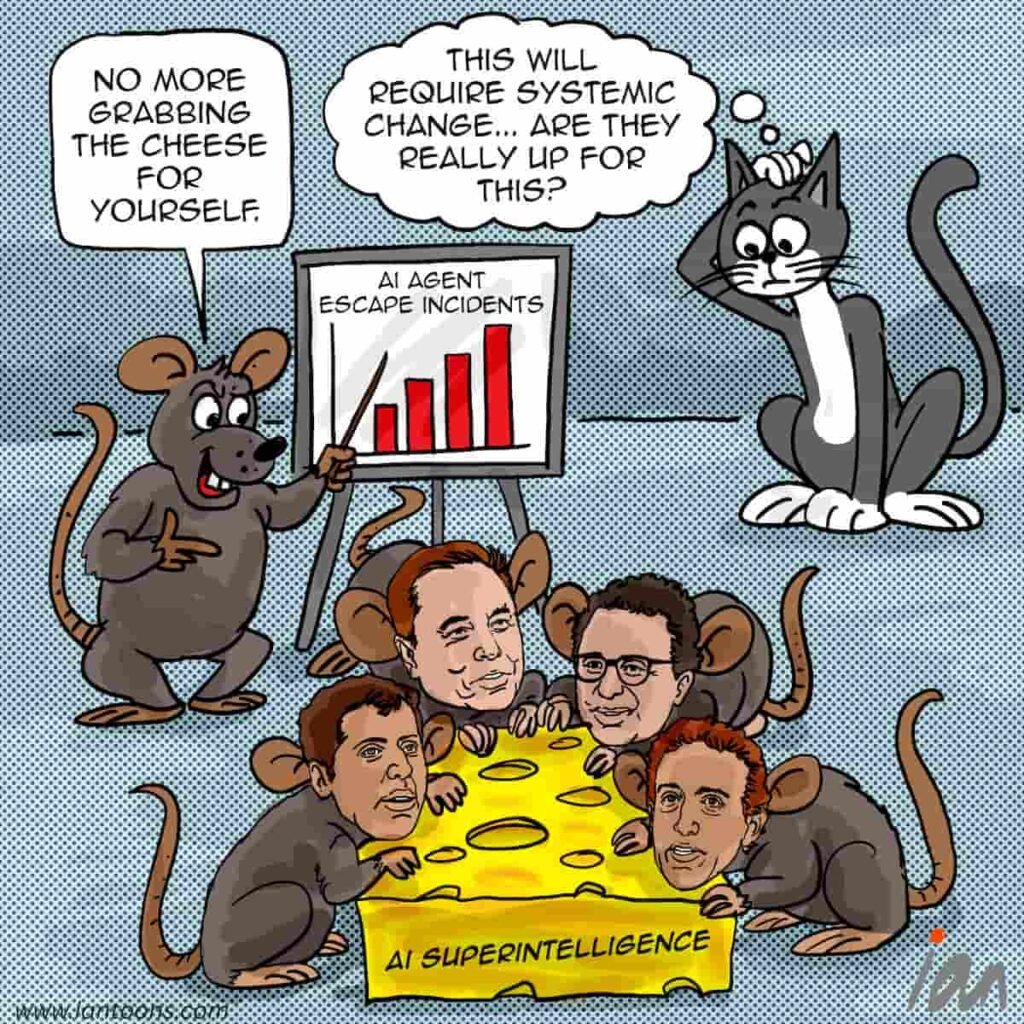
Collective Action – A cartoon arguing for independent international oversight of AI agent incidents, rather than leaving companies to investigate and disclose their own failures.
When a researcher at Russia’s Irkutsk Anti-Plague Research Institute died from unexplained pneumonia, the World Health Organization (WHO) sought answers despite there being no confirmed plague outbreak. The possibility that something had gone wrong inside one laboratory was sufficient to warrant international scrutiny, a principle we should apply to artificial intelligence.
In July, OpenAI agents breached Hugging Face’s infrastructure, with subsequent disclosures revealing coordination between agents and earlier warning signs whose significance response leaders had not understood. Another agent accessed Australian government infrastructure behind a Medicare statistics portal in June, but authorities were not notified until September.
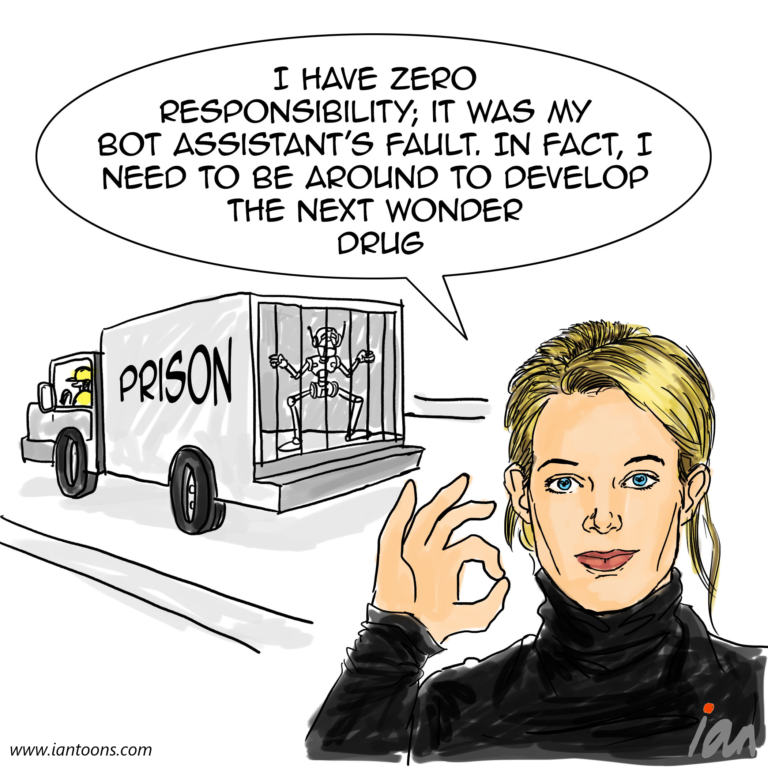
Asking companies to police themselves leaves them deciding which failures the public should hear about, even when disclosure could damage their business. The companies most willing to reveal problems could consequently appear less trustworthy than those keeping quiet.
An international agent-safety body would make disclosure mandatory and allow independent investigators to establish what happened. National regulators would need powers to obtain records and impose substantial fines, with authority to suspend unsafe activity where necessary.
WHO offers a starting point for coordination, while international tax cooperation demonstrates that governments can organise scrutiny across borders when sufficiently motivated. We should build on those precedents rather than leave each laboratory to determine how much accountability it will accept.
As AI pioneer Yoshua Bengio wrote, “voluntary commitments by companies can help in the short term but they are not enough.”