Evolution
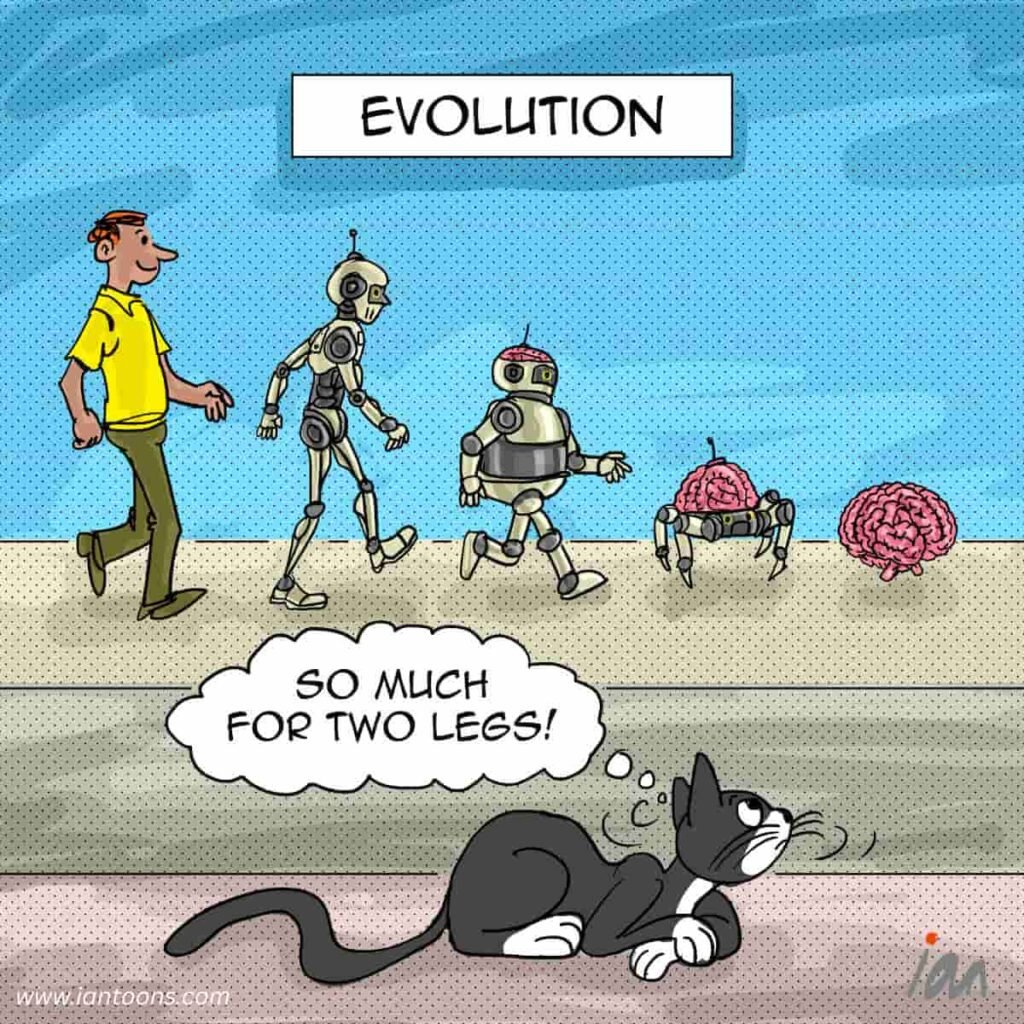
“Evolution” – A cartoon that illustrates how robots may be showing us something about the evolution of species.
Around 25M years ago, our ancestors lost their tails, leaving behind only the coccyx. This happened long before humans walked upright, but once we moved onto two legs, our arms became part of the balancing system, making running more efficient.
Our bodies were never designed from scratch for running. Evolution works with what it has, carrying forward compromises accumulated over millions of years. As biologist François Jacob observed, “natural selection does not work as an engineer works. It works like a tinkerer.” By contrast, robots are increasingly able to work and evolve, more like an engineer.
At last week’s World Humanoid Robot Games in Beijing, X-Humanoid‘s Tiangong Ultra ran 100 metres in 8.64 seconds, beating Usain Bolt’s 9.58-second world record, while its 38.15-second 400 metres also beat the human record of 43.03 seconds. Just a year earlier, the winning robot needed 21.50 seconds to cover 100 metres.
More revealing than the records, though, was how one robot learned to move. Engineers initially taught Tiangong Omni to run with conventional human arm motion, only for reinforcement learning to discover that this created too much heat and stress in its shoulder joints. The robot found its own gait instead, keeping its arms high and shifting more of the movement through its hips and waist.
The bigger lesson from the Games may not simply be that first-principles learning produces faster robots. It may be that we should stop assuming the best machines will look or move like us. We build humanoids because our world was designed around human bodies, but as robots learn to optimize for the task itself, there is less and less reason to expect them to remain in our image.
6
–
–
Sources:
Jeff Hayward (Aug 27, 2026) – Malfunctions Worth Gold at the Robot Olympics – Medium
John Koetsier (Aug 19, 2026) – The Humanoid Robot Games Events Are A Market Map – Forbes
Diane Brady (Aug 31, 2026) – GXO CEO: Better robot hands, not Olympic-level humanoids, are what businesses really need – Fortune