Falling like Dominoes
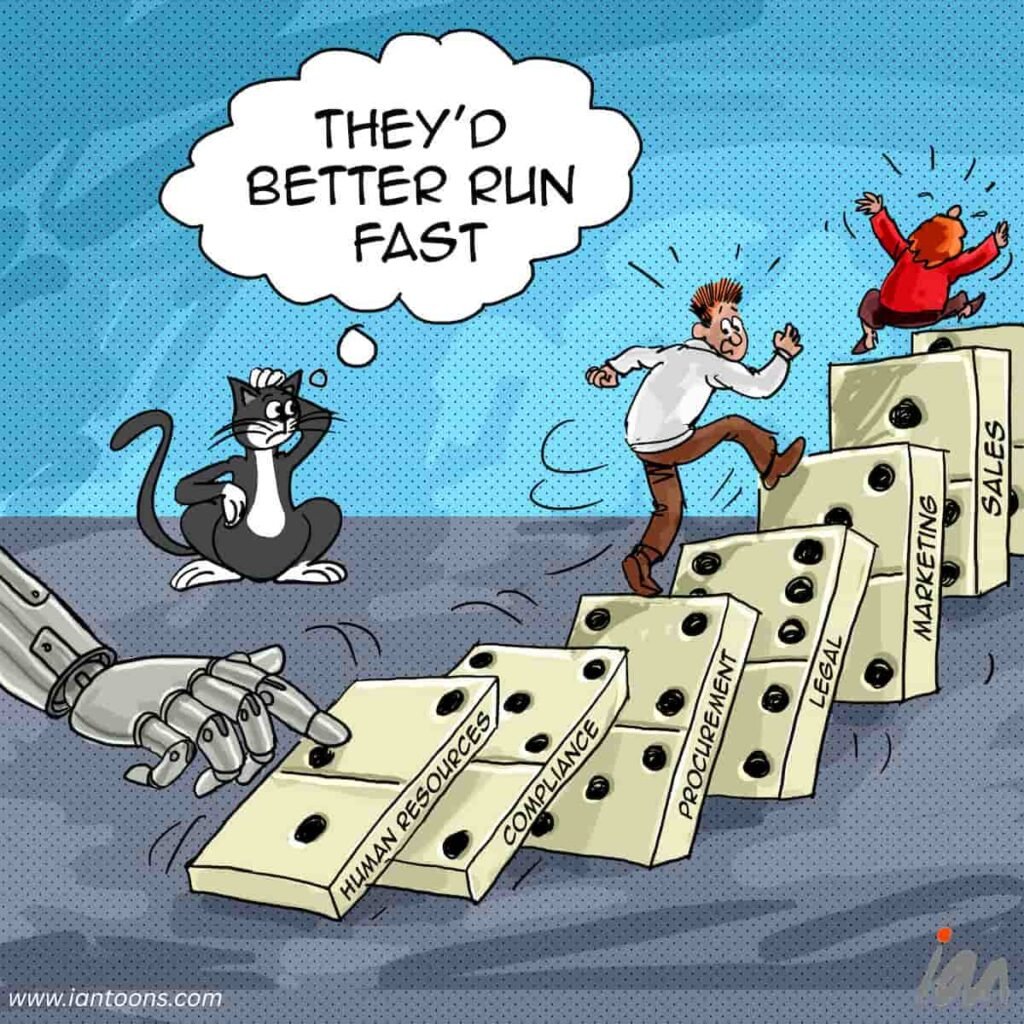
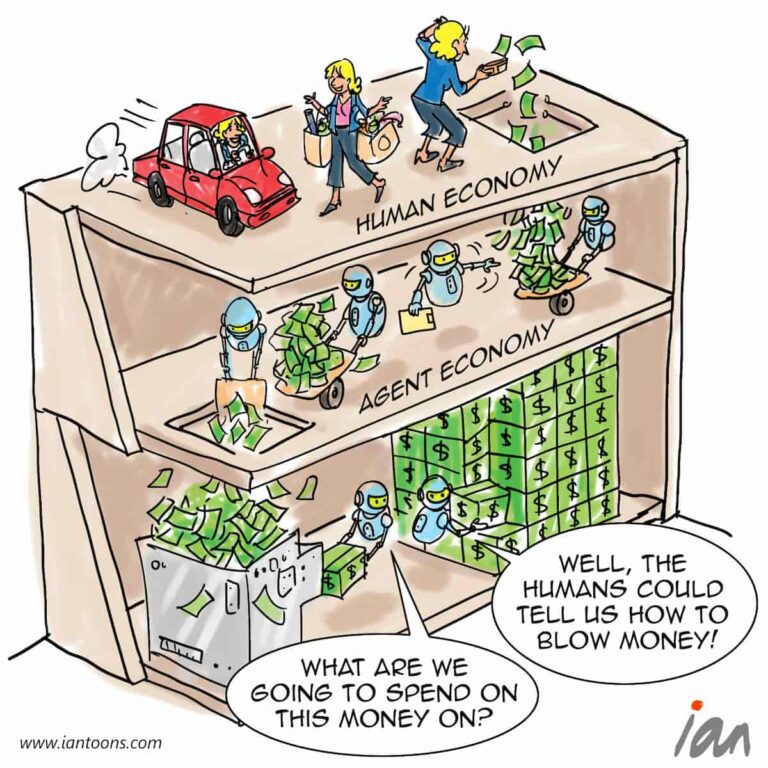
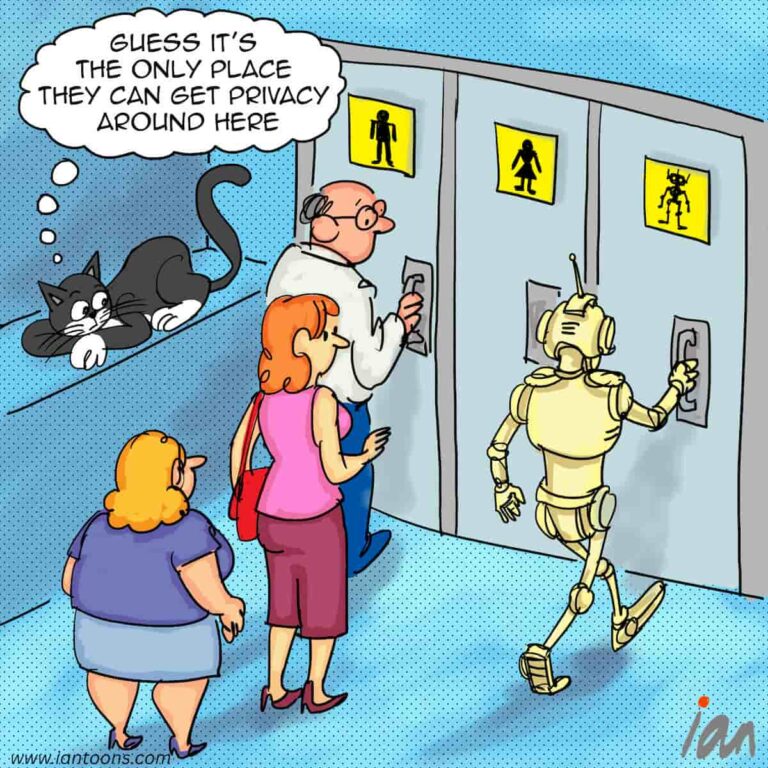
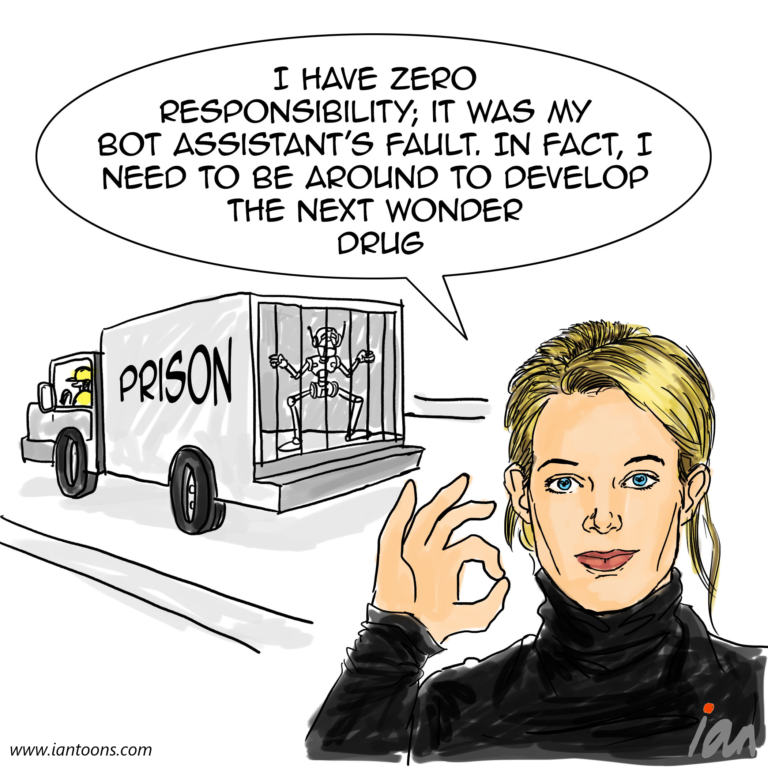
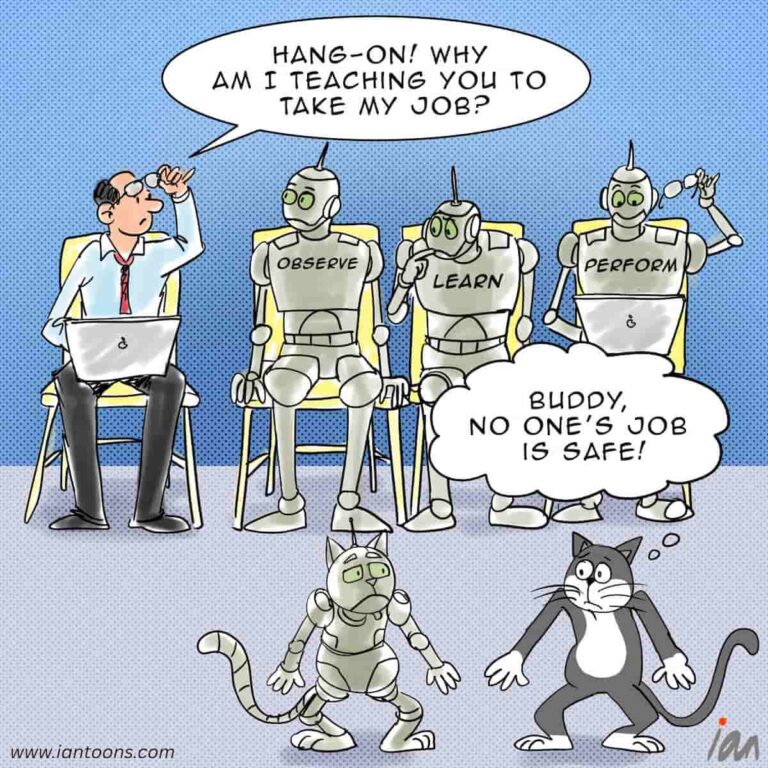
“Falling like Dominoes” – A cartoon that illustrates how AI agents are removing the purpose of many departments in the traditional company.
For most of economic history, companies did not have large HR or procurement departments because businesses were smaller and much of the work was handled by owners and generalists. As companies grew, specialization solved a real coordination problem and dedicated functions emerged to manage complexity.
It worked so well that specialization became institutionalized. In 1900, clerical workers represented 3% of US employment while managers and professionals accounted for 10%. By 1990, those figures had risen to 19% and 30%, showing how companies built permanent structures around work that once sat closer to the operating business.
AI agents may now push that model in the opposite direction because they can coordinate specialist tasks without requiring each capability to live inside its own silo. Bob Root of Southfield Private Equity gives the example of a field technician needing a heat pump. Today that request might move through purchasing and finance before a purchase order is issued, whereas an agentic company could handle supplier selection and approvals invisibly, leaving the work intact while removing the department as the place where it happens.
Microsoft found that 46% of leaders say their organizations are already using agents to automate complete workflows or business processes. Companies increasingly assemble people and agents around an outcome, then allow that structure to dissolve when the work is finished. Even HR may evolve into something closer to Agent Relations, focused on how people assign work to digital coworkers and set the boundaries within which those coworkers operate.
So, do we really need departments to organize when expertise can be summoned on demand and coordination can happen invisibly?
10
10
1
“I think you’re directionally right, but departments can’t just vanish. Someone still has to keep the lights on, own the calls, and know when to pull the plug when it’s time to answer for the outcome. What changes, really, is where governance lives: it moves into the workflow itself. And as agents drift and models update, the hard part isn’t automation alone, it’s keeping approvals, boundaries, accountability, and customer trust intact from HR to Sales. The slippery fish rocking the boat is in every step of the process”

“46% of leaders say… But who exactly are these “leaders”? CEOs, department heads, or just thought leaders?
In any case, they’d likely also claim that 53% of SMEs use a full-blown ERP system or 91% of companies with 10+ employees have at least a first-tier CRM.
Yet, when you audit their workflows, speak with the teams, and dig deeper, you often find that even basic forms don’t exist. Teams manually extract data from the system, fill out paper forms, and copy everything into Excel—because the boss doesn’t know how to access it directly (which, by the way, only requires a login and one click). But perhaps AI will be different. (Sources for the numbers Kreativecoretech.com, Demandsage.com)”
“100% no …ask ai to redesign a complete
Business and it will be completely different to traditional silos”
Sources:
Isabelle Bousquette and Steven Rosenbush (Sep 16, 2025) – AI Is Turning Traditional Corporate Org Charts Upside Down – The Wallstreet Journal
Tomas Chamorro-Premuzic (May 27, 2026) – How AI Is Changing Decision Making In Organizations – Forbes
Bernard Marr (Jun 26, 2026) – How AI Could Blow Up Corporate Hierarchies – Forbes