

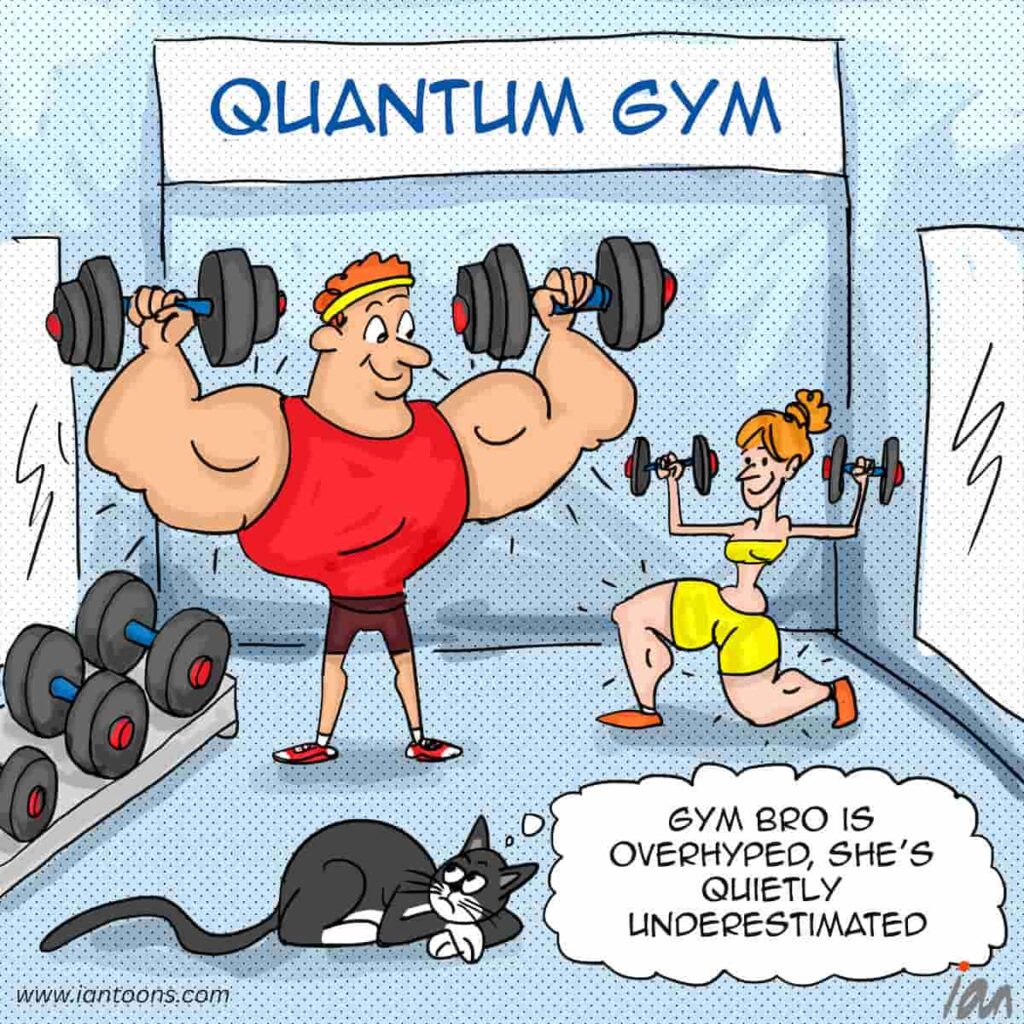
Quantum Computing Is Both Overhyped and Underestimated
The hardware race gets the headlines, the software layer is already cashing the checks
I. The Instrument Nobody Notices
Every phone in every pocket already runs on quantum mechanics without anyone treating it as news, because PS only works at all thanks to atomic clocks that track time through quantum transitions precise enough to place a car on the correct side of a highway. Nobody files that under quantum computing, and technically it isn’t, but the instinct to treat quantum as a technology still waiting in the wings gets harder to defend once you notice how much of daily life already leans on quantum mechanics doing unglamorous work.
The industry’s own story explains the blind spot. Technically, quantum computing resembles classical computing in the 1950s, real science capable of remarkable calculations, though still expensive and fragile enough to sit closer to a scientific instrument than a commercial product, even as IBM and Google and Quantinuum and IonQ keep pushing qubit quality and error correction forward. Commercially, it looks more like artificial intelligence before ChatGPT, a technology that was already powerful while the companies built on top of it kept hunting for the product a normal customer would understand on sight, the kind of product that could reach an estimated 100 million monthly users within two months the way ChatGPT did. Quantum has promising work waiting in drug discovery and materials science, in finance and logistics too, but it hasn’t yet found the equivalent moment that makes its value obvious to someone outside the field.
The money arrived ahead of that moment anyway. IonQ and Rigetti and D-Wave all reached public markets through SPAC transactions, the same instinct that fueled crypto’s ICO boom, capital funding a future before the business models underneath it had matured. What that capital bought varies enormously: IonQ reported $130 million in 2025 revenue, up 202 percent year over year, while Rigetti reported $1.9 million in fourth-quarter revenue against a $22.6 million operating loss. Two companies in the same young industry, both treated by headlines as evidence of the same story, are actually proof of how uneven that story still is underneath, which is the whole trouble with calling quantum overhyped and underestimated at the same time.
II. The Horse Everyone’s Still Riding
The current AI boom depends on a fairly brute-force kind of progress, chasing capability by building more chips and more power than the generation before it needed, which is why so much capital is flowing into data-centre architecture right now, a reasonable move in the short term since the market rewards whoever delivers capacity fastest. But it also means infrastructure built for a smaller, slower era, the silicon and the grids underneath it, is being stretched to do work it was never designed to handle at this scale, and the more interesting shift isn’t foward bigger server farms so much as toward a stack of computing that stops depending on silicon to do all of it alone.
That shift is why the hardware story people keep telling about quantum, bigger qubit counts, cleaner coherence times, gets the actual bottleneck backwards. Richard Gavan, CEO of the quantum software company Haiku, argues that for enterprise research teams the real constraint has rarely been the hardware alone so much as the time and expense of designing and prototyping experiments on it. Two camps split the field for years, one insisting nothing meaningful could happen before full fault tolerance arrives, which could still be a decade away, the other willing to find out what today’s noisy, only partially corrected machines can already do.
“Quantum computing is supposed to be a society positive thing once it’s useful, so why not try and speed it up?”
RICHARD GAVAN, HAIKU
Gavan’s team put a number on that speed-up. A molecular dynamics simulation that had previously required nine hours and roughly $30,000 of compute, using standard error-mitigation techniques and published on the cover of Nature Physics, was reproduced by Haiku for about $25 in thirty seconds, a thousandfold drop achieved almost entirely through smarter orchestration software running on the same hardware. Phasecraft has been chasing the same kind of leverage from the algorithm side instead. Its co-founder Toby Cubit points out that clever mathematics has already cut the qubits and gates required to simulate certain materials problems by a factor of a million, the equivalent of buying back a decade of hardware development without building a single new chip.
“Useful, very large quantum computers can indeed be built.“
HARTMUT NEVEN, GOOGLE QUANTUM AI
Neven said that after Google’s Willow milestone, and it reads less like a boast than an obituary notice for the assumption that silicon was the only serious computing substrate left to bet on.

III. Harvest Now, Decrypt Later
Nearly every part of daily life now runs online, banking and healthcare and work, along with the more private exchanges people increasingly have through something like ChatGPT, and almost all of it rests on encryption that assumes certain math problems are too hard for any computer to solve inside a human lifetime. Multi-factor authentication alone is now standard at almost 90 percent of large enterprises, each login a small bet that the cryptography underneath it holds. Quantum computers threaten that bet directly, since algorithms like Shor’s could eventually cut the time needed to break RSA or ECC encryption from centuries to hours, and even today’s early, noisy devices have already shown glimmers of that power, IBM among them, having demonstrated measurable quantum speedups on 27- qubit processors using error-mitigated algorithms.
That threat is why the harvesting has already started. State actors, China and North Korea among them, are stockpiling encrypted archives now, financial records and medical histories and military communications, betting that a future quantum computer will let them read later what they cannot read today. Skeptics point out that most of what gets hoarded this way is digital junk, though the concern was never really about the junk so much as whatever happens to be buried inside it.
“We know adversaries are harvesting data now to decrypt later. The transition to post-quantum cryptography isn’t just a technical upgrade, it’s a race to secure the future before the future arrives.”
ANNE NEUBERGER, U.S. DEPUTY NATIONAL SECURITY ADVISOR
A counter-offensive is already underway. NIST released its first three post-quantum cryptography standards in 2024, and companies including IBM and PQShield and SandboxAQ are racing to embed them into live systems before the other side’s wager pays off.

IV. The Rock Star Problem
Boston Consulting Group estimates quantum computing will drive more than $800 billion in value over the next thirty years, a number large enough to make the industry’s current bottleneck look almost quaint by comparison, since realizing it requires a workforce that has historically lived almost entirely inside narrow corners of academic physics.
“A lack of available quantum scientists and engineers may be an inhibitor of the technology’s growth.”
WILLIAM OLIVER, MIT
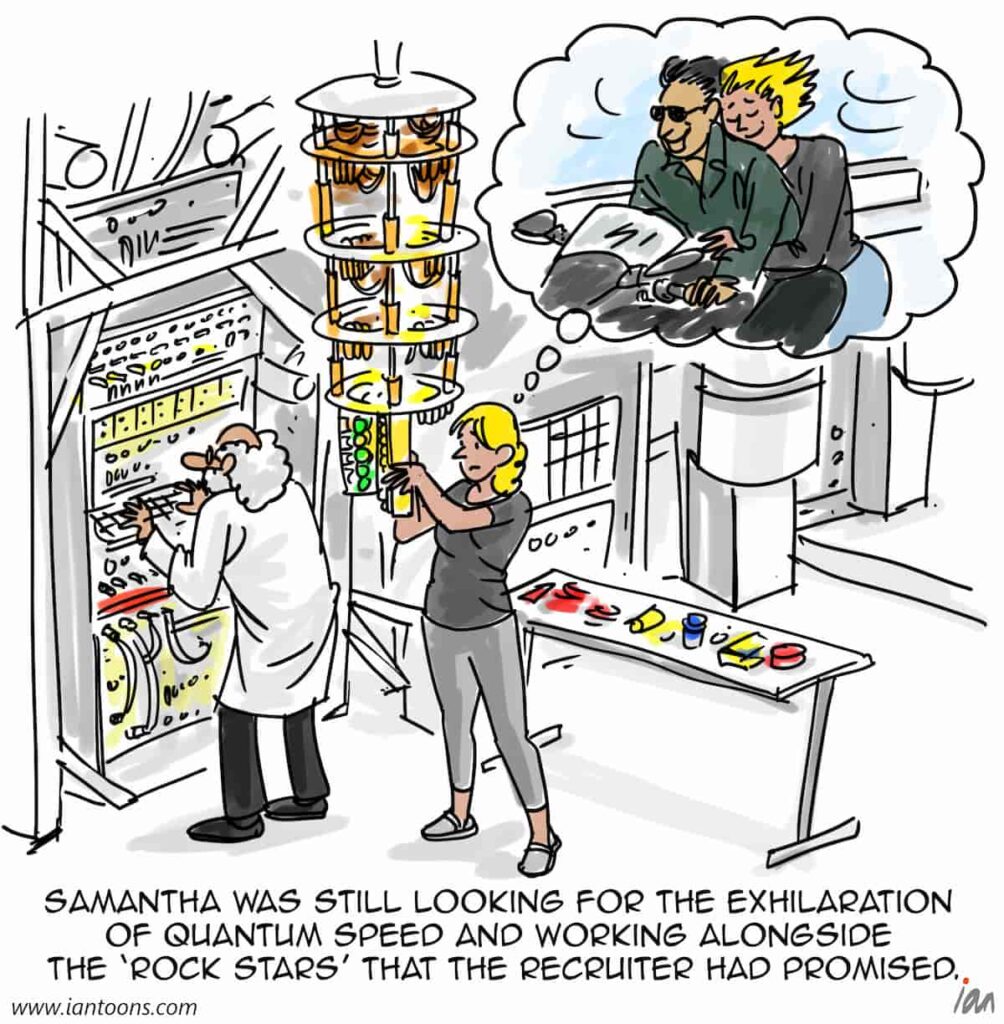
Some companies are responding by building education programs aimed at mid-career engineers who never had a clear path into the field, and scholarship programs aimed at widening who gets to walk through that door in the first place. Other recruiters are simply chasing the reputation premium, poaching talent that incumbent players already spent years training. Somewhere underneath both approaches sits the gap between the pitch given to new hires, the promise of quantum speed and colleagues described as rock stars, and the slower reality of actual lab work, assembling hardware by hand and debugging noise for months before anything resembling speed shows up.
V. The Estimate Was Always a Ceiling
Every number the industry has published about what quantum computing needs before it becomes useful has turned out to be a ceiling rather than a floor. Toby Cubit put it more bluntly than most people in the field are willing to.
“Every time someone says resource estimate, it’s not a resource estimate. It’s a resource upper bound.”
TOBY CUBIT, PHASECRAFT
IBM’s Darío Gil describes the current moment in similar terms, without the edge. “We are firmly within the era in which quantum computers are being used as a tool to explore new frontiers of science,” he said, and quantum’s next era begins the moment those frontiers turn into products a customer cannot afford to ignore, though nobody gets to announce that moment in advance either. The way you’ll know it’s arrived is that the companies closest to it go quiet rather than loud, since nobody wants a competitor to know they’ve found something worth keeping to themselves.
The industry will keep measuring itself in qubits, because qubits are countable and countable numbers make for clean headlines. The actual progress is happening a layer underneath the count, the same way an atomic clock in a satellite has been quietly doing quantum computing’s job inside your pocket for years without anyone thinking to call it that.
38
14
2
“Great work. Always Love the cartoons. Thank you. Your “overhyped and underestimated” take names the qubit-count obsession I’ve been working on from the hardware side. Published a piece on it two days ago I think sits in your lane. Would value your read. — Cory, ProtoDynamics”

“Loved your post. Thanks for summarizing overhyped and underestimated in such a fun way 😊”

“The cartoon captures the challenge well — funding, R&D, incubators and pilots can create momentum, but the “Quantum Business Case” still has to prove it can truly lift off.
That is perhaps where the “overhyped vs underestimated” debate becomes interesting: the hype often sits around hardware milestones, while the underestimated part may be the harder journey of converting quantum capability into repeatable, scalable and economically meaningful outcomes.”
“The trick with quantum is that productizing it is extremely simple.
It’s always going to be the latest keys rolled against narrow windows of current timestamps.
It takes a lot of time and money and resources to get that extremely right, but for the masses to benefit from quantum solutions, that’s the eternal playbook compatible with how quantum is ever evolving.”
“Agree, Ian Foley, quantum computing is both overhyped, first, and then, underestimated. Time will surprise us.”

“Wonderful article that explains the challenges and opportunities in plain English! Well done Ian Foley 👏”

“Ian, I strongly encourage you to check out embark.day and give me your thoughts. Our first product is an advanced cybernetic toolkit for video and decisions. API being launched now.”