Caveat Emptor

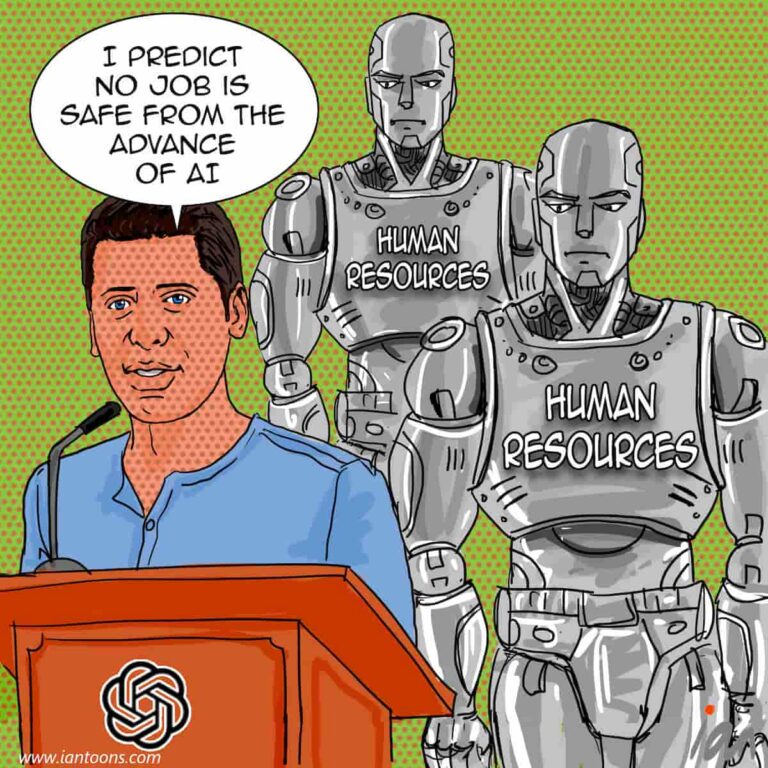
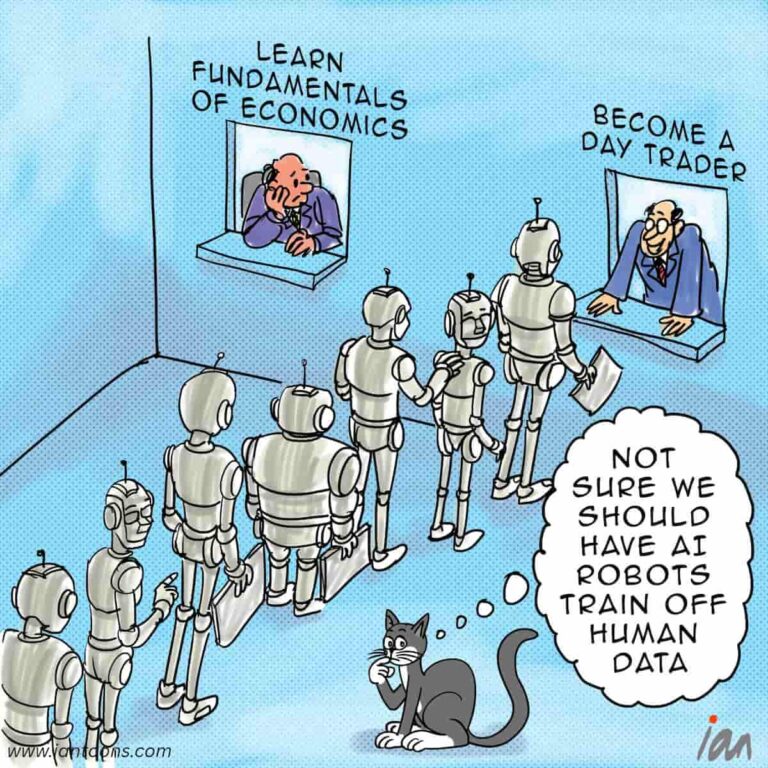
“Caveat Emptor” – a cartoon illustrating that the economics of AI are closer to the restaurant industry than traditional software.
For the past two decades, software has been defined by one extraordinary economic advantage in that once built, it could be sold endlessly at almost no additional cost. Serving the thousandth customer was no more expensive than serving the first. But AI fundamentally changes this software business model. Unlike traditional software, AI generates outputs in real time. Every query, every automated workflow, every generated response consumes compute. Intelligence is not stored and reused … it is produced on demand.
This makes the AI industry more like running a restaurant, a notoriously unprofitable business often run for love. In a restaurant, every meal must be prepared fresh, every ingredient has a cost, and success depends not just on attracting customers, but on ensuring each plate can be served profitably.
At scale, AI introduces costs that traditional software largely avoided. For example, a SaaS company providing document search to 50,000 enterprise users. In a traditional model, once the indexing system is built, each additional search costs almost nothing, often less than $0.00001. Even with 10 million searches per day, annual infrastructure costs might remain under $500,000, because the system retrieves existing results. Now consider the same product rebuilt using AI, where each search generates a new answer. If those same users perform 200 AI-powered searches per day, that results in 10 million AI queries daily. At $0.01 per query, annual compute costs exceed $36 million. The user experience may feel similar, but the economics are entirely different.
As Sundeep Goel, CEO of Mavvrik, warned, “My prediction is CFOs are going to have huge cost overruns” as AI pilots move into production.