Payday
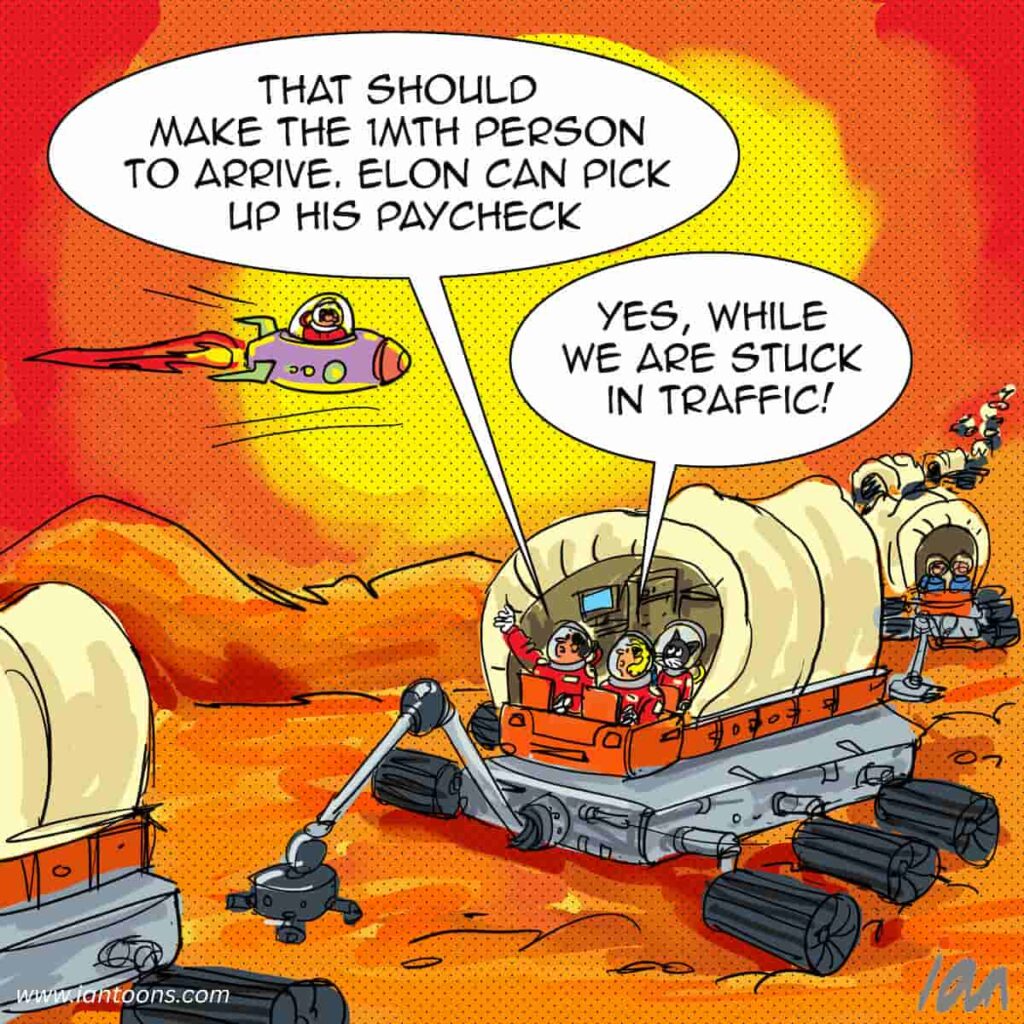
Payday – A cartoon that illustrates why Elon Musk’s pay package tied to a Martian colony might increase the chance of this happening.
For more than two decades, Elon Musk has built a career on pursuing goals that most people considered unrealistic. In 2008, both Tesla and SpaceX were close to collapse. Tesla was running out of cash, while SpaceX had suffered three consecutive launch failures. Musk invested nearly all of his remaining personal fortune to keep both companies afloat. That decision ultimately paid off. Today, Tesla is worth hundreds of billions of dollars, while SpaceX generated $18.7 billion of revenue in 2025 and has become the world’s dominant launch provider. Starlink alone has grown to more than 10 million subscribers globally.
What separates Musk from most entrepreneurs is not intelligence or capital, but his willingness to pursue objectives regardless of the odds. As Musk famously said, “when something is important enough, you do it even if the odds are not in your favor.” The latest example comes from SpaceX’s IPO filing. According to reports, Musk can receive up to 200 million super-voting shares if SpaceX reaches a $7.5 trillion valuation, establishes a permanent Mars colony, and that colony reaches 1 million residents. A separate award of 60.4 million shares is tied to the development of massive orbital computing infrastructure.
Most CEOs are paid for revenue growth, earnings, or share price appreciation. Musk’s compensation is linked to building a civilization on another planet.
At first glance, a one-million-person Mars colony sounds impossible. Yet reusable rockets, orbital booster landings and a global satellite internet network once sounded impossible too. What matters is that the most ambitious goal in modern business is now tied directly to the incentives of the entrepreneur with perhaps the strongest track record of achieving outcomes others dismissed as unrealistic.
9
2
1
“The reward is the 200 million super-voting shares which changes what’s being purchased entirely. I think Musk already sits at the motivation ceiling because a man who put his last dollar into both companies in 2008 doesn’t push harder because the payout got bigger. So the package buys control (not drive) and it pegs that control to a milestone no board can call failed for decades.”

Sources:
Eva Roytburg (May 20, 2026) – Elon Musk’s proposed pay package in SpaceX’s IPO filing reveals what the company actually is: a $1 trillion monster built to colonize Mars – Fortune
Ty Roush (May 22, 2026) – Everything SpaceX And Tesla Say Elon Musk Must Do—Mars Colony, Robots, More—For More Billions – Forbes
Ty Roush (May 21, 2026) – Musk’s Mars Colony Plans And SpaceX Control Could Derail Starlink Profits, Analyst Says – Forbes