Quantum Imbalance
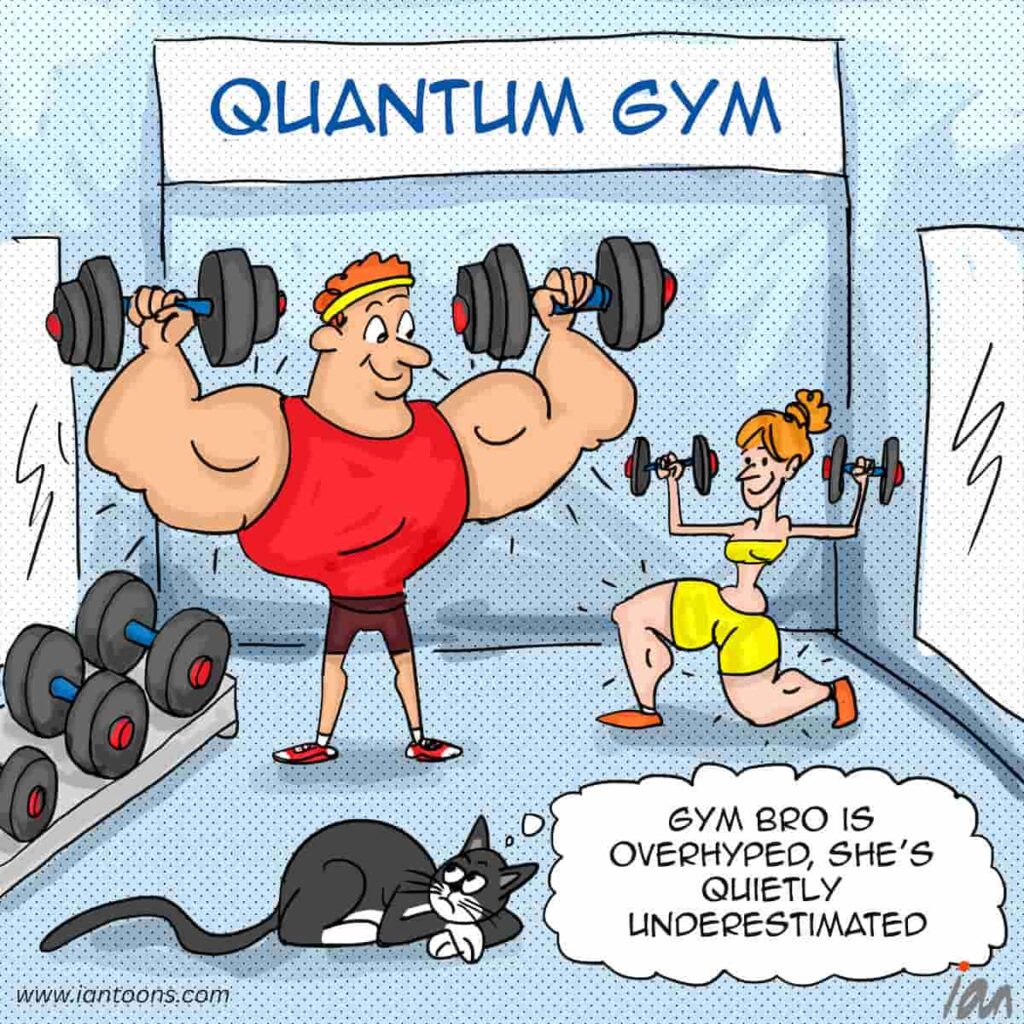
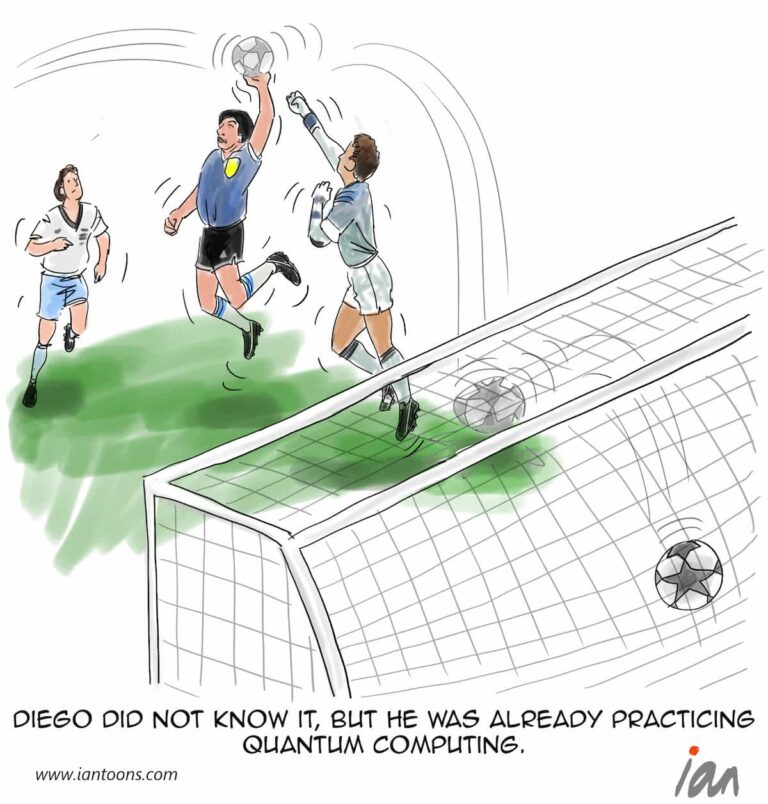
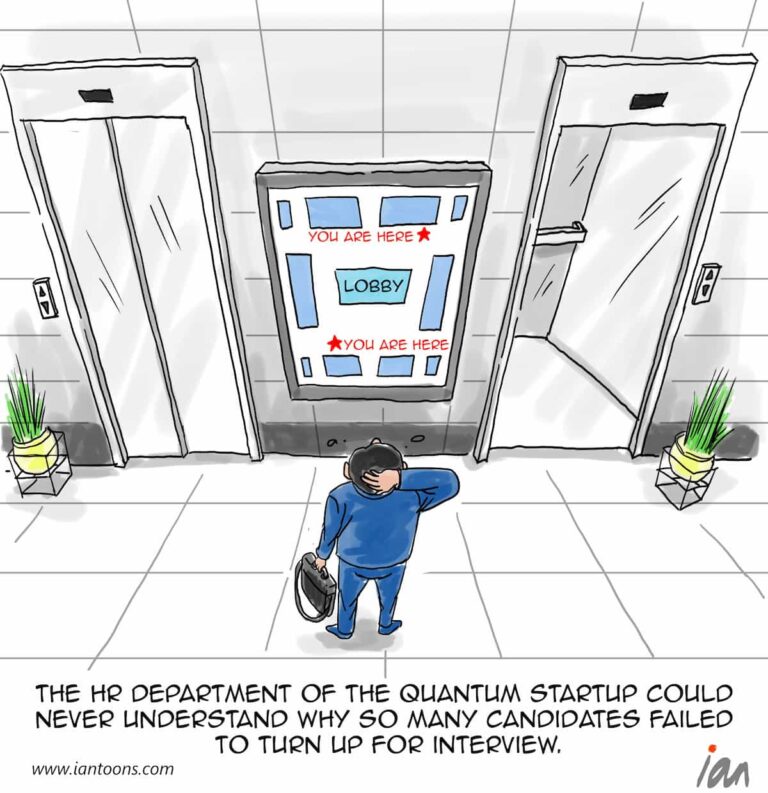
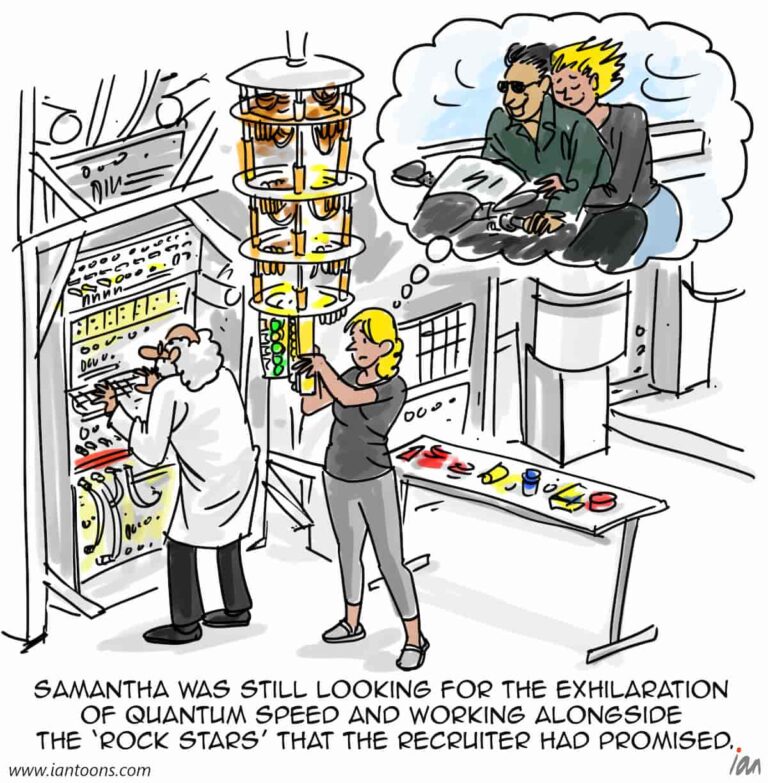
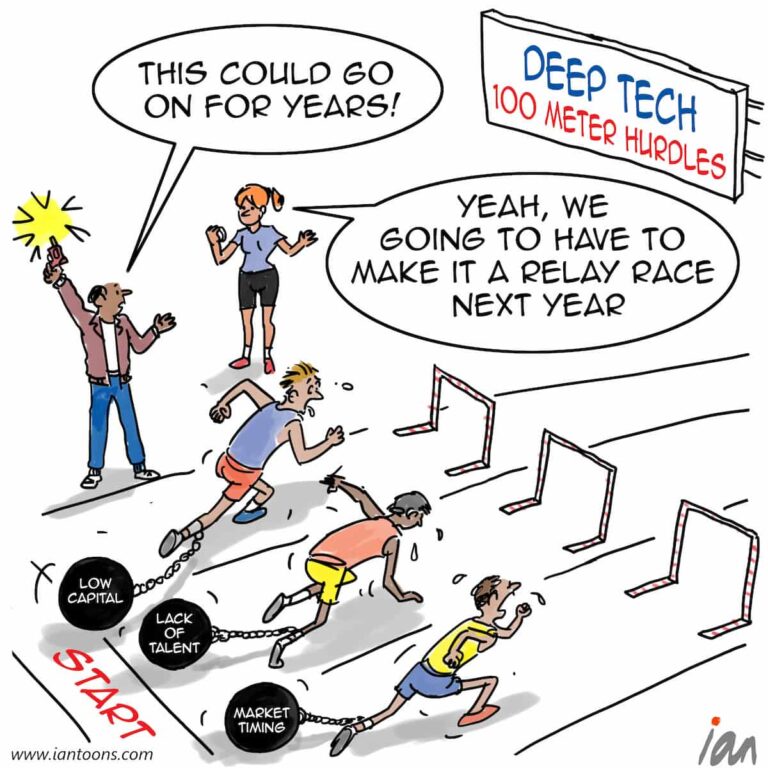
“Quantum Imbalance” – a cartoon illustrates that quantum computing can feel both overhyped and underestimated, largely because parts of the industry are building muscle at very different speeds.
Technically, quantum resembles classical computing in the 1950s. The science is real and the machines can perform remarkable calculations, but they remain expensive, fragile and difficult to operate. IBM, Google, Quantinuum, IonQ and Rigetti are steadily improving qubit quality and error correction, yet today’s systems are still closer to scientific instruments than general-purpose commercial computers.
Commercially, quantum looks more like artificial intelligence before ChatGPT. AI was already powerful, but most companies were still searching for products that customers immediately understood and wanted. ChatGPT changed that by turning complex technology into a simple experience and reaching an estimated 100 million monthly users within two months. Quantum has promising applications in drug discovery, materials science, finance and logistics, but it has not yet found an equivalent product that makes its value obvious.
The investment cycle belongs to another era again. IonQ, Rigetti and D-Wave entered public markets through SPAC transactions, reflecting investors’ willingness to fund the industry’s future before its business models had matured. That dynamic also recalls crypto’s ICO boom, when capital flowed into infrastructure long before dependable commercial applications emerged.
The financial gap between companies shows how uneven the market remains. IonQ reported $130 million in 2025 revenue, up 202% year over year, while Rigetti reported only $1.9 million in fourth-quarter revenue alongside a $22.6 million operating loss.
As IBM Research Director Darío Gil said, “We are firmly within the era in which quantum computers are being used as a tool to explore new frontiers of science.” Quantum’s next era will begin when those frontiers become products customers cannot afford to ignore.
9
3
1
“Quantum is running three clocks at once and they are badly out of sync. Capital moves on the ICO-era clock, the applications on the pre-ChatGPT clock, the physics on the 1950s clock. But also I would say ChatGPT did not create a capability because it exposed a general one that was already sitting behind an API. Quantum’s edge is narrow by construction as it wins on specific problem structures, not on breadth so its obvious-value moment may never arrive as a legible consumer product. More likely it lands upstream (as a better catalyst or a materials result) and gets captured by whoever owns that workflow. The interesting question is who that ends up being.”

“Great cartoon, Ian — it captures the tension perfectly. Quantum computing is still in the “scientific instrument” phase: real progress is happening, but the systems remain fragile, expensive, and far from everyday commercial use. The error-correction overhead and hardware challenges mean useful, large-scale applications are still years away for most companies. This is exactly the gap we’re addressing at QuantumWolff. While the industry continues building better physical qubits, we focus on delivering practical quantum-scale chemistry and materials simulations on classical hardware today. No need to wait for fault-tolerant machines or massive infrastructure.The companies that will win in the medium term are likely those that can turn quantum-inspired insight into usable products now — not only those waiting for the hardware to fully mature. Curious to hear how others see the balance between long-term quantum hardware and near-term classical solutions.hashtag#QuantumComputing hashtag#QuantumChemistry hashtag#DeepTech hashtag#QuantumWolff www.quantumwolff.com”

“is that Schrodinger’s Cat that survived?”

Sources:
Chuck Brooks (Jul 28, 2026) – AI And Quantum Are Impacting Cyber Risk. Boards And CISOs Must Prepare – Forbes
Anna Broughel (May 07, 2026) – How Quantum Computing Can Solve Energy And Climate Challenges – Forbes
Chuck Brooks (Jun 13, 2026) – The Quantum Frontier: How Quantum Computing Is Reshaping Our Future – Forbes